EV Telematics Solutions: Driving Smarter Connected Fleet Management
As electric vehicle adoption accelerates worldwide, fleet operators face growing challenges such as battery degradation, unexpected downtime, rising maintenance costs, and limited visibility into vehicle performance. Traditional fleet management approaches are no longer sufficient for software-defined vehicles. This is where EV telematics solutions help organizations monitor vehicle health, optimize battery performance, and improve operational efficiency through real-time data and connected intelligence.
The global EV market is projected to exceed 250 million vehicles on the road by 2035, while connected vehicle technologies are growing at over 16% CAGR. As this shift accelerates, the ability to capture and act on real-time vehicle data is becoming a defining operational advantage.
EV telematics solutions use connected devices, IoT, GPS, CAN Bus data, and cloud platforms to monitor electric vehicle health, battery performance, driver behavior, and fleet operations in real time, enabling predictive maintenance and smarter fleet management.
What Are EV Telematics Solutions?
At its core, an EV telematics solution combines onboard sensors, CAN bus communication, GPS, and cloud analytics to turn raw vehicle data into operational decisions.
Unlike conventional GPS tracking, which mainly shows where a vehicle is, EV telematics reveals how the vehicle is performing internally. It taps into the Battery Management System (BMS) and vehicle control units to surface metrics that don't exist in traditional fleet tracking, such as State of Charge (SoC), State of Health (SoH), and cell-level temperature variance.
For fleet managers, this shifts the conversation from “where is my vehicle” to “will my vehicle make it through today's route without failing?”
Why Businesses Need It
Electric vehicles generate significantly more data than internal combustion vehicles, but most fleet operators aren't equipped to use it. That gap creates real operational risk.
Common challenges include:
- Battery uncertainty: Operators often can't see degradation until range or performance visibly drops. EV batteries account for approximately 30-40% of total vehicle cost, making this blind spot expensive.
- Reactive maintenance: Scheduled servicing or breakdown-driven repairs miss early warning signs like controller faults or thermal anomalies. Industry research suggests predictive maintenance can reduce unplanned downtime by 30-50% compared with reactive approaches.
- Manual software management: Updating firmware across a fleet without remote tools means recalls, workshop visits, and lost vehicle-hours.
- Safety blind spots: Harsh braking, aggressive acceleration, and overspeeding quietly erode both battery efficiency and driver safety.
Traditional fleet management tools weren't built for these problems. They were designed around fuel and mileage, not battery chemistry and software-defined vehicle behavior. This is why purpose-built EV telematics has become a decision-making necessity rather than a nice-to-have.
How It Works
EV telematics solutions follow a continuous data pipeline:
Vehicle → Sensors → CAN Bus → Telematics Device → Cloud → Dashboard → Alerts → Business Action
- Vehicle & Sensors: Battery cells, motor controllers, and power electronics constantly generate performance data.
- CAN Bus: This internal network carries that data between vehicle systems in real time.
- Telematics Device: A connected device reads and decodes CAN data, including reverse-engineered protocols for non-standard OEM systems.
- Cloud Transmission: Data moves securely, chip-to-cloud, using encrypted communication protocols.
- Dashboard: Fleet managers view SoC, SoH, location, and diagnostics in one interface.
- Alerts: The system flags anomalies, a falling SoH trend, a thermal spike, a fault code, before they escalate.
- Business Action: Maintenance teams intervene early, dispatchers reroute vehicles, and operations planning improves.
Core Technologies Behind EV Telematics Solutions
- CAN Bus Integration: Decodes real-time vehicle and battery data directly from the source.
- Battery Management System (BMS) Data Access: Delivers SoC, SoH, charging cycles, and cell-level insights.
- AI and Machine Learning: Detects behavioral deviations and predicts failures before they occur.
- Cloud Connectivity: Enables centralized monitoring across geographically distributed fleets.
- Vehicle Firmware Over-The-Air (VFOTA): Pushes software updates remotely, without workshop visits.
- Cybersecurity Architecture: Protects vehicle data through encrypted chip-to-cloud transmission.
Business Benefits
Reduced unplanned downtime. Predictive diagnostics catch early fault indicators, a gradually rising motor temperature, for instance, before they cause a breakdown mid-route.
Extended battery life. Continuous SoC and SoH monitoring helps operators avoid charging and usage patterns that accelerate degradation, protecting a component that makes up a significant share of an EV's total cost.
Lower service costs. VFOTA eliminates the need to recall vehicles for software fixes, cutting workshop visits and technician hours across large fleets.
Improved driver safety. AI-based behavior analytics identify harsh braking or overspeeding patterns, allowing targeted coaching instead of blanket policy changes.
Better fleet visibility. A single dashboard replaces spreadsheets and phone calls, giving operations teams a live, unified view of vehicle health and location.
Real-World Use Cases
- Logistics: Reduce delivery delays through predictive maintenance that flags issues before vehicles fail mid-route.
- Public Transport: Improve fleet availability with remote diagnostics that catch faults between scheduled service intervals.
- Mining: Monitor heavy electric vehicles operating in remote locations where physical inspection is difficult and costly.
- Last-Mile Delivery: Optimize battery performance and maximize vehicle uptime across dense, high-frequency delivery routes.
- Cold Chain Distribution: Track battery performance to ensure refrigerated EV fleets maintain range under continuous power draw.
Traditional vs. Connected Approach
| Factor | Traditional Approach | Connected EV Telematics |
|---|
| Maintenance | Reactive or fixed-schedule | Predictive, condition-based |
| Battery Monitoring | Manual or absent | Continuous SoC/SoH tracking |
| Software Updates | Workshop visits, recalls | Remote (VFOTA) |
| Fault Detection | After failure occurs | Early anomaly detection |
| Driver Safety | Post-incident review | Real-time behavior analytics |
Future Trends in EV Telematics Solutions
Fleet intelligence is moving toward software-defined vehicles, where features and performance improvements roll out via updates rather than hardware changes. AI-driven predictive analytics will become more granular, forecasting component-level failures weeks in advance. Digital twin models, virtual replicas of physical fleets, will let operators simulate route and usage scenarios before committing vehicles. As smart city infrastructure expands, connected fleets will increasingly exchange data with charging networks and traffic systems, tightening the link between vehicle intelligence and urban mobility planning.
Why Choose iTriangle
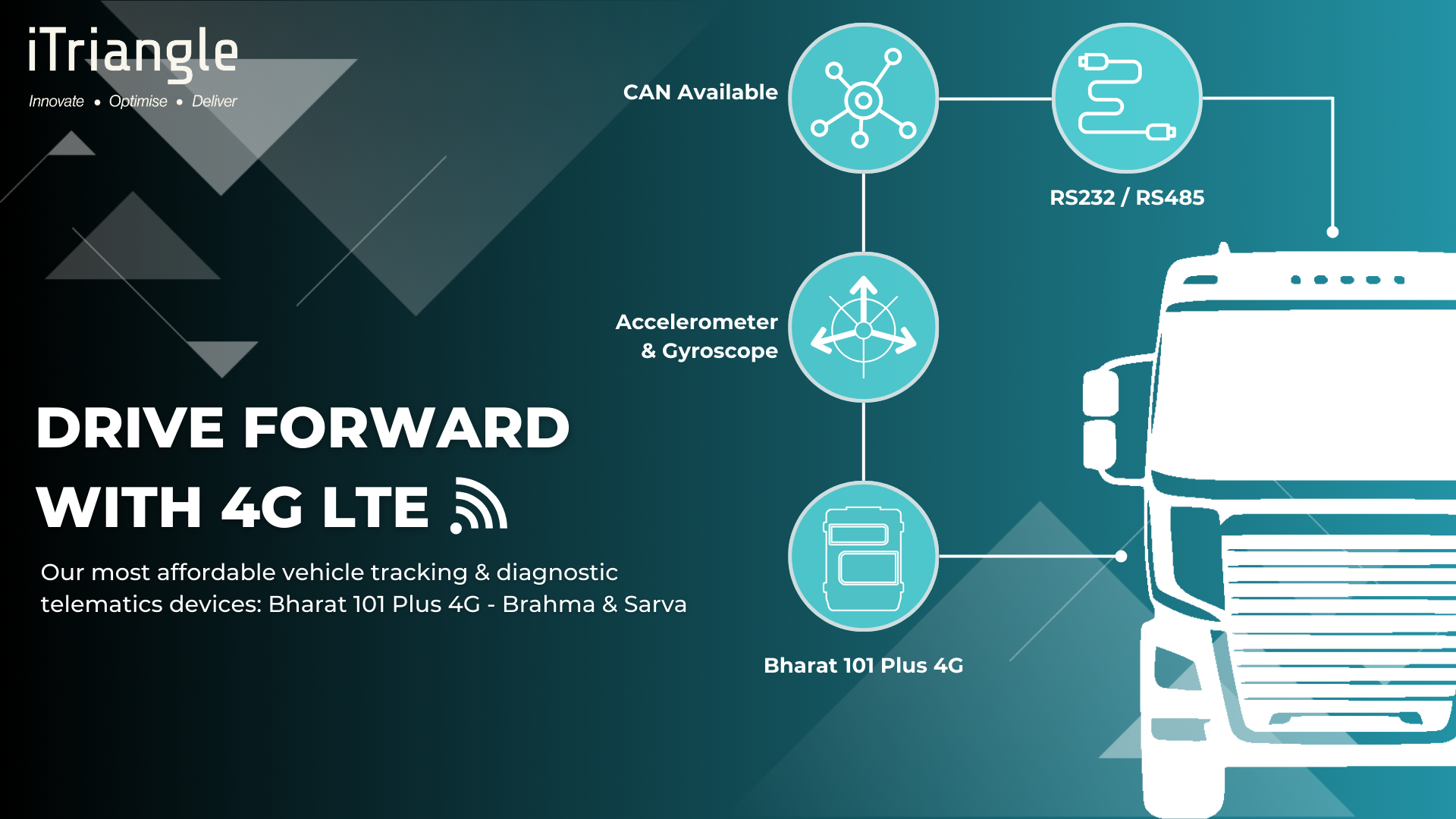
iTriangle has spent over a decade building CAN-based vehicle intelligence for OEMs, fleet operators, and mobility providers across India, the Middle East, and Africa. Its telematics platforms, including Bharat101 Plus 4G and TS101 Basic EV CAN, combine deep BMS data access, secure chip-to-cloud architecture, and remote diagnostics with reverse-engineered CAN support for non-standard vehicle systems.
Beyond the technology itself, iTriangle is built for how real fleets actually operate:
- Supports multi-OEM fleets: Reverse-engineered CAN capabilities mean fleets running vehicles from different manufacturers can still be monitored on one platform.
- Scales from small fleets to enterprise deployments: The same architecture that supports a handful of vehicles supports thousands.
- Integrates with existing enterprise systems: Fleet data can feed into broader operations and maintenance workflows rather than sitting in a silo.
- Supports ICE, hybrid, and electric vehicles: Useful for organizations transitioning gradually rather than switching fleets overnight.
- Built for real-world commercial fleet operations: Solutions are engineered around the practical demands of logistics, transit, mining, and delivery fleets, not generic use cases.
This combination of indigenous R&D and field-tested deployment experience is what allows iTriangle to support the complexity of Indian and emerging-market vehicle ecosystems at scale.
Conclusion
As electric mobility continues to evolve, organizations that adopt EV telematics solutions will be better equipped to improve battery health, reduce downtime, optimize maintenance, and increase fleet productivity. By combining connected vehicle intelligence, AI-powered analytics, and predictive maintenance, businesses can build safer, more efficient, and future-ready fleet operations. Explore how iTriangle's intelligent telematics solutions can help transform your EV fleet.