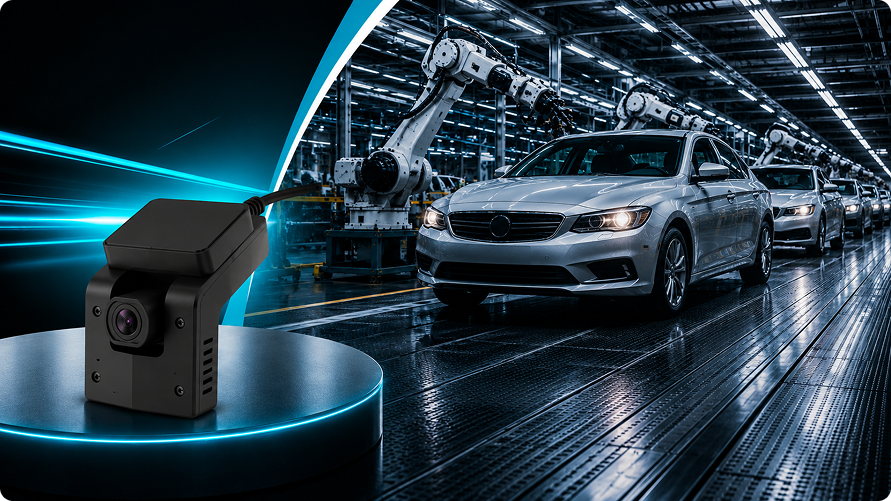
OEM Vehicle Manufacturers: Why iTriangle’s AW500 Dashcam is Essential
Introduction: OEMs Leading India’s Road Safety
Vehicle manufacturers (OEMs) around the world are operating in an increasingly competitive and technology-driven automotive market. As governments introduce stricter safety regulations, connected vehicle requirements, and intelligent mobility initiatives, OEMs are under growing pressure to integrate advanced safety technologies while maintaining cost efficiency and protecting long-term profitability.
India serves as a strong case study for these global trends. The country manufactures approximately 5.85 million vehicles annually, with the automotive industry contributing 7.1% to India’s economy. India is also expected to become the third-largest automotive market globally by 2030, making it one of the world’s most important manufacturing hubs for passenger and commercial vehicles.
Indian OEMs operate in an environment shaped by evolving regulations, increasing customer expectations, and intense market competition. The Ministry of Road Transport and Highways (MoRTH) is introducing new electronic monitoring and video telematics requirements for commercial vehicles, while the existing AIS-140 mandate has already driven annual telematics market growth of over 20%. Although these figures are specific to India, they reflect a broader global movement toward connected, software-enabled, and safety-focused vehicles.
Like manufacturers worldwide, Indian OEMs must balance manufacturing efficiency, supply chain challenges, rising material costs, warranty management, and the integration of increasingly sophisticated electronic systems, all while remaining competitive in price-sensitive markets.
The Problem: Big Challenges for Indian OEMs
High Warranty Costs Due to Driver Behavior: Warranty claims continue to create significant financial pressure for vehicle manufacturers worldwide. Distinguishing between genuine manufacturing defects and failures caused by driver behaviour remains a major challenge.
The National Consumer Disputes Redressal Commission ordered Tata Motors to pay ₹41,000/US $426 after refusing warranty service, while Mercedes-Benz India paid ₹2 lakh/US $2,078 following ongoing vehicle issues. Similar cases involving Maruti Suzuki included ₹60,000/US $623 penalties where courts found insufficient evidence of driver negligence. These examples demonstrate a universal challenge: without objective evidence, manufacturers often struggle to defend warranty decisions, increasing legal costs and financial exposure.
Upcoming Video Telematics Rules and Compliance Costs: Governments worldwide are introducing stricter vehicle safety and monitoring regulations, particularly for commercial vehicles. The Ministry of Road Transport and Highways (MoRTH) is finalizing video telematics regulations, while Section 136A of the Motor Vehicles Act already requires electronic monitoring across highways and urban areas. The success of the AIS-140 mandate has resulted in more than 100 certified device manufacturers, highlighting India’s rapid adoption of connected vehicle technologies.
Certification requirements such as ISO 184 and DVVP add further compliance responsibilities. In India, certification costs range from ₹2,999/US $31.16 to ₹1,20,000, depending on complexity, while comprehensive compliance programs may exceed ₹10 lakh/US $1,247. Although these figures are specific to India, similar compliance costs and certification requirements are becoming increasingly common across international automotive markets.
Aftermarket Challenges and Lost Revenue: Capturing aftermarket revenue remains a global challenge for OEMs. The country’s automotive aftermarket contributes only 6% of the total Original Equipment market compared with the global average of 25–30%, representing an estimated ₹20 billion/US $208 million untapped opportunity.
Manufacturers also face increasing complexity:
- Approximately 20% of OEM parts are updated annually
- Nearly 700,000 unique part numbers require management
- Unofficial aftermarket suppliers continue offering lower-cost alternatives
- Customers remain uncertain about warranty coverage after vehicle modification.
These issues reflect broader global challenges surrounding aftermarket services, digital parts management, and customer retention.
Rising Manufacturing and Material Costs: OEMs around the world continue to face increasing raw material costs that directly impact profitability.
Indian OEMs face rising input costs that directly reduce their profits. Metal costs make up 8-16% of revenues for crucial parts like the car body, chassis, and engine components. After the BS-VI emission rules, more precious metals like palladium and platinum are used, significantly raising production costs. Material price fluctuations create ongoing problems. Steel prices hit peak levels, leading Indian automakers to raise prices by an average of 2% across their vehicle lines. Companies like Maruti Suzuki increased average vehicle prices by 8.8% since January, and premium brands like BMW and Mercedes-Benz announced at least 3% price increases to offset material costs.
The Solution: iTriangle’s AW500 Smart AI Dashcam System
ISO 184 Compliant Dual-Camera System: The AW500 meets OEM integration needs with its ISO 184 compliance and DVVP certification. This ensures it fits smoothly into vehicle manufacturing. It features two cameras: a 1080P road-facing camera and a 720P driver-facing camera, both with a wide 140° view. This comprehensive coverage meets upcoming MoRTH video telematics rules.
This compliance framework removes regulatory uncertainty, offering OEMs a future-proof solution that meets current AIS-140 standards and upcoming video telematics regulations. DVVP certification guarantees the system meets the Ministry of Road Transport and Highways’ specifications for commercial vehicle integration.
Advanced Driver Monitoring (DMS) and ADAS: The AW500’s built-in AI tackles warranty claim issues with powerful Driver Monitoring System (DMS) features. It detects and records dangerous driver behaviors like drowsiness, distraction, phone use, smoking, and not wearing a seatbelt. This gives OEMs clear proof to defend against unfair warranty claims.
Advanced Driver Assistance Systems (ADAS) features include forward collision warnings, lane departure alerts, and pedestrian detection. This creates multiple layers of evidence for accident investigations. This detailed monitoring helps OEMs distinguish between manufacturing defects and driver negligence, protecting them from costly warranty disputes that average ₹41,000/US $426 to ₹2 lakh/US $2,078 per incident.
Easy Factory Installation (Plug-and-Play): The AW500’s ready-for-retail design allows for easy factory installation. Setup costs range from ₹3,000/US $31.17 to ₹10,400/US $108.04, much lower than custom solutions.
Professional dashcam installation typically costs ₹5,000/US $51.94 to ₹15,000/US $155.83, making the AW500 an affordable factory-fitted option that adds value to vehicles. The system’s tough build and wide dynamic range ensure reliable performance across India’s varied climates. Loop recording and sensor functions automatically save incident footage without manual effort. It connects easily with existing vehicle systems and fleet management platforms.
Cloud-Based Evidence Management: The AW500 automatically uploads critical event footage to secure cloud storage along with encrypted GPS coordinates and timestamps, creating tamper-resistant records for warranty documentation, accident investigations, insurance claims, and regulatory reporting. This cloud-based evidence management simplifies administrative processes while improving transparency and accountability. In addition, the connected platform enables OEMs to offer value-added services such as fleet telematics, predictive maintenance, driver coaching, remote diagnostics, and vehicle analytics. These capabilities create new recurring revenue opportunities while helping manufacturers differentiate their vehicles in increasingly competitive global automotive markets.
Key Benefits: Strategic Advantages for OEM Operations
- Protect Against Warranty Claims and Legal Costs: The AW500's detailed recording protects OEMs from unfair warranty claims that have caused significant financial losses. With objective video evidence of driver behavior and vehicle operation, manufacturers can defend against disputes that previously resulted in ₹41,000/US $426 to ₹2 lakh/US $2,078 payouts. The system helps OEMs tell the difference between manufacturing flaws and driver errors, preventing warranty abuse while maintaining genuine customer service.
- Meet Regulations and Future-Proof Your Business: ISO 184 and DVVP certifications ensure OEMs meet current and future regulations, avoiding expensive retrofitting later. As video telematics rules progress through MoRTH, early adoption provides a competitive edge, avoiding costly last-minute implementations that typically cost 2-3 times more than planned integrations.
- Boost Aftermarket Revenue: The AW500, as a high-profit accessory, helps OEMs increase aftermarket revenue. This addresses the big gap where India only captures 6% of aftermarket potential, compared to the global 25-30%. Its ready-to-sell design and simple installation create opportunities for dealer sales and service programs, strengthening customer relationships and generating extra income.
- Support Dealers and Differentiate Vehicles: Factory-integrated dashcam technology gives dealerships a compelling safety and technology feature that helps differentiate vehicles in increasingly competitive markets. Advanced driver safety systems improve perceived vehicle value and support premium positioning for both passenger and commercial vehicles. Using India as a case study, where only 42% of dealers are profitable, value-added technologies such as the AW500 help justify pricing, improve customer confidence while enhancing the overall ownership experience.
- Optimize Manufacturing & Lifecycle Costs: Integrating the AW500 during vehicle production enables OEMs to benefit from economies of scale, reducing per-unit costs compared with aftermarket installations. Its rugged construction, industrial-grade components, and extensive validation testing minimize electronic failures throughout the vehicle lifecycle, reducing warranty service requirements and post-sales support costs. By improving reliability while simplifying factory integration, the AW500 helps manufacturers maintain quality standards and improve long-term operational efficiency.
- Enable Data-Driven Services: The AW500's cloud-connected platform enables OEMs to expand beyond traditional vehicle manufacturing by offering value-added digital services. Real-time data supports predictive maintenance, driver coaching, fleet optimization, remote diagnostics, and connected vehicle analytics, creating recurring revenue opportunities while improving customer engagement. This transition toward software-enabled mobility services reflects a broader global trend in the automotive industry, allowing OEMs to strengthen long-term customer relationships while building new business models.
Conclusion: Build the future of Connected Vehicle Safety
The combination of evolving regulations, growing customer expectations, and increasing competition presents a significant opportunity for OEMs worldwide to strengthen their market position through intelligent vehicle safety technologies. India serves as a compelling case study, where the progression of video telematics regulations, increasing warranty claims, and pressure on dealer profitability demonstrate the broader challenges facing automotive manufacturers across global markets.
Every delay in adopting advanced video telematics exposes manufacturers to avoidable warranty disputes, rising compliance costs, and missed opportunities to differentiate their vehicles.
The iTriangle AW500 is more than a dashcam, it is a connected safety platform that helps OEMs reduce warranty risks, simplify regulatory compliance, strengthen dealer networks, and unlock new digital revenue streams. With ISO 184 compliance, DVVP certification, and readiness for evolving video telematics requirements, it provides manufacturers with a future-ready solution that supports safer vehicles, smarter operations, and sustainable business growth.
Manufacturers that integrate intelligent video telematics today will be better positioned to lead tomorrow’s connected mobility landscape. Early adoption delivers long-term competitive advantages, while delayed implementation increases compliance costs and reduces opportunities for market differentiation.
Contact iTriangle today to schedule an AW500 evaluation and discover how intelligent video telematics can help future-proof your vehicle portfolio while creating lasting value for your customers and your business.
Featured Products
FleetNex AW500

Applicable Markets:
🇮🇳 India
In Partnership With: