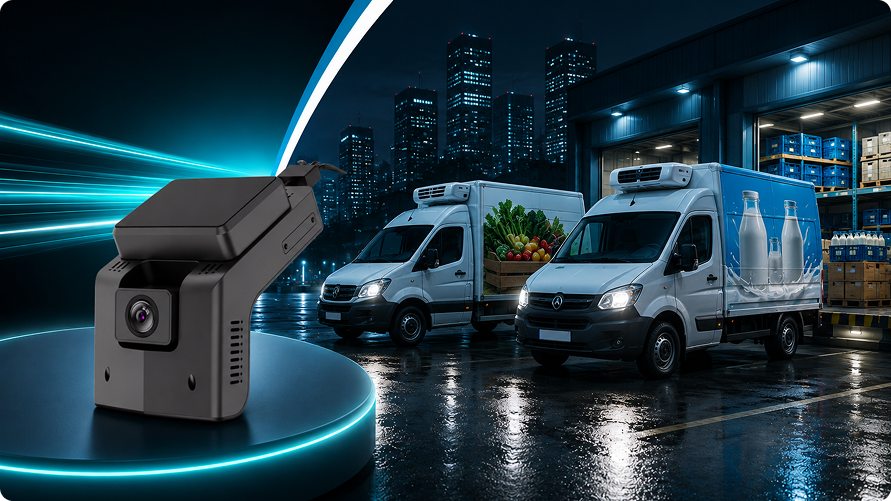
Keeping Milk & Fresh Goods Safe: How iTriangle’s AW500 Dashcam Helps
Introduction: The Big Problem with Cold Deliveries in India
Across the world, cold chain logistics providers face a common challenge, maintaining product quality while transporting temperature-sensitive goods through increasingly complex supply chains. Delays, temperature fluctuations, infrastructure limitations, cargo theft, and regulatory compliance all impact the safe delivery of perishable products.
This case study highlights these challenges through the example of India, one of the world’s largest producers of milk and fresh agricultural products. While the data presented is specific to India, the operational issues discussed are highly relevant to cold chain operators globally.
India produces and transports 209 million tonnes of milk and approximately $10,390 USD worth of fruits and vegetables every year. Every journey from production to consumption is a race against time, temperature, and transportation challenges. Approximately 3% of India’s total milk production, around 6.3 million tonnes, is lost annually due to inadequate refrigeration and transportation delays. This is equivalent to filling nearly 250,000 milk tankers and represents an estimated $1.87 billion USD in lost revenue.
The situation is even more critical for fresh produce, where 30-40% of fruits and vegetables spoil before reaching consumers, resulting in economic losses of approximately $5.19 billion USD each year. Despite these challenges, India currently has cold storage capacity for only 11% of its agricultural produce, while refrigerated transportation remains limited. This leaves dairy companies, food processors, logistics providers, and cold chain operators exposed to spoilage, cargo theft, regulatory risks, insurance claims, and reputational damage.
The experience of India’s cold chain sector demonstrates how even a single weak link in the transportation process or an unexpected road incident, can result in significant financial losses within minutes.
The Problem: Hidden Costs, Major Headaches, and Growing Risks
Although the following statistics relate specifically to India, they illustrate challenges commonly faced by temperature-controlled logistics operators worldwide.
Spoilage and Product Quality Loss:
- Power outages at rural milk collection centers contribute to the loss of approximately five million tonnes of milk annually.
- Temperature fluctuations during transportation spoil approximately 15% of fruits and vegetables, reducing both quality and shelf life.
- Every one-hour transportation delay at 35°C can reduce fresh produce quality by the equivalent of twenty hours of ideal cold storage, significantly shortening product shelf life and increasing product discounts and waste.
Limited Cold Storage and Refrigerated Transport:
- India currently operates approximately 6,300 cold storage facilities, with most concentrated in only four states, leaving many transportation corridors underserved.
- Refrigerated transport capacity remains limited. Milk and dairy products utilize the majority of available refrigerated vehicles, forcing many other perishable goods to be transported in conventional trucks.
- Highway congestion and transportation delays cost the industry an estimated $10.39 billion USD annually through increased fuel consumption, waiting time, and product spoilage.
Road Accidents and Liability Risks:
- Accidents involving milk tankers and refrigerated vehicles have resulted in significant compensation awards, including $0.114 million USD in Chennai, $3.05 million USD in Thane, and $0.231 million USD in Delhi, particularly where video evidence was unavailable.
- Courts, including the Karnataka High Court, have upheld compensation in fatal accident cases where transport operators lacked supporting video evidence.
- Across India, refrigerated transport incidents contribute to some of the highest insurance losses within the commercial vehicle sector, resulting in insurance premiums that are 15-30% higher than those for standard commercial trucks.
Cargo Theft, Route Deviations & Manual Monitoring:
- Up to 40% of perishable goods are transported in open vehicles without GPS tracking or secure cargo monitoring.
- Unauthorized route deviations, fuel theft, and temperature manipulation remain difficult to detect and verify.
- According to the National Centre for Cold-Chain Development (NCCD), inadequate shipment verification and incomplete transportation records can result in product recalls, warranty disputes, and contractual penalties.
Evolving Regulations & Warranty Requirements
India’s Ministry of Road Transport & Highways (MoRTH) is introducing draft regulations that include video telematics, Advanced Driver Assistance Systems (ADAS), and Driver Monitoring Systems (DMS) for commercial transport vehicles. In addition, ISO 184 and DVVP certification are increasingly becoming preferred requirements among vehicle manufacturers. Fleet operators without compliant video telematics systems may face registration challenges, reduced compliance readiness, and potential warranty implications.
The Solution: AW500 – Your ISO 184-Compliant, Smart AI Protector.
The iTriangle AW500 is a rugged, standalone dual-camera dashcam designed for the demanding requirements of cold chain and temperature-controlled logistics. While this case study highlights its application in India, the solution is equally relevant for dairy, food, pharmaceutical, and refrigerated transport fleets worldwide.
- Two HD Cameras with 140° Wide View: A 1080P Full HD road-facing camera and a 720P HD cabin-facing camera, each with a 140° wide-angle view, capture every journey in detail, from route changes and sudden braking to loading, unloading, and driver activity.
- AI-Powered Driver Monitoring (DMS): The built-in Driver Monitoring System (DMS) provides real-time alerts for driver fatigue, mobile phone usage, seatbelt violations, and smoking. These proactive warnings help reduce the risk of incidents that could compromise valuable temperature-sensitive cargo.
- Advanced Driver Assistance System (ADAS): ADAS features provide alerts for potential forward collisions, lane departures, and pedestrian detection, helping reduce accident risks during both urban deliveries and long-distance transportation.
- Instant Cloud Upload & Live GPS Tracking: When an event is detected by the sensor (such as sudden braking or a collision), or when the emergency button is pressed, encrypted video, GPS location, and event data are automatically uploaded to the cloud. This creates a secure, tamper-resistant record for fleet managers, quality teams, insurers, and regulatory authorities.
- DVVP Certified & Ready for MoRTH Regulations: The AW500 is DVVP-certified and compliant with upcoming MoRTH video telematics requirements in India. Its future-ready architecture also helps fleet operators prepare for evolving video telematics and safety regulations across global markets.
- Easy Plug-and-Play Installation: Designed for rapid deployment, the AW500 can typically be installed in under 30 minutes on milk tankers, refrigerated trucks, delivery vans, and two-wheeler delivery fleets, minimizing installation time and operational disruption.
Key Benefits: Real Savings and No More Risks
- Reduced Product Spoilage: Continuous video monitoring and location-based alerts help fleet supervisors respond quickly to operational issues that could impact cold chain integrity. In the India case study, preventing spoilage of just 5,000 litres of milk per month protects the $0.0104 USD per litre cold-chain quality incentive, allowing an AW500 investment to pay for itself in less than three months.
- Lower Insurance & Legal Costs: Objective video evidence helps resolve accident disputes quickly, reduces fraudulent claims, and simplifies insurance investigations. In the India case study, avoiding a single compensation claim of approximately $31,165 USD can offset the cost of deploying AW500 devices across an entire 40-vehicle fleet. Many insurers also recognize video telematics as a risk-reduction measure, potentially lowering insurance premiums over time.
- Regulatory Compliance & Warranty Protection: By supporting ISO 184 compliance and India's upcoming MoRTH video telematics guidelines, the AW500 helps fleet operators avoid future hardware upgrades and reduces the risk of warranty disputes associated with driver behavior. These protections are particularly valuable for high-cost components such as refrigerated units and vehicle chassis.
- Reduced Theft & Route Deviations: Encrypted cloud video synchronized with GPS timestamps provides verifiable records of cargo handling, helping deter theft, validate delivery events, and investigate route deviations. This is particularly valuable when transporting high-value shipments, including loads worth $10,390 USD or more.
- Improved Driver Performance & Fuel Efficiency: Real-time driver behavior monitoring helps reduce harsh braking, speeding, and unsafe driving habits that increase fuel consumption and cargo damage. Even a 5% improvement in fuel efficiency on a 250 km daily route can save approximately $1,558 USD per truck annually at current fuel prices.
- Greater Customer Confidence: Retailers, food processors, pharmaceutical companies, and export customers increasingly expect greater visibility across the cold chain. Video evidence, combined with GPS tracking and operational records, helps demonstrate transportation quality, strengthen customer trust, and support long-term commercial relationships.
Conclusion: Act Now, Before Disaster Strikes.
As demonstrated in this India case study, cold chain operators can lose significant revenue due to spoilage, cargo theft, accidents, and operational inefficiencies. India alone loses approximately $7.06 million USD every day from these combined challenges.
With new compliance rules ahead, the AW500 offers dual-camera AI safety, evidence capture, and easy operation, saving loads, avoiding lawsuits, and protecting your brand. Act now. Contact iTriangle for a demo and secure your cold chain.
Featured Products
FLEETNEX AW500

Applicable Markets:
🇮🇳 India
In Partnership With: