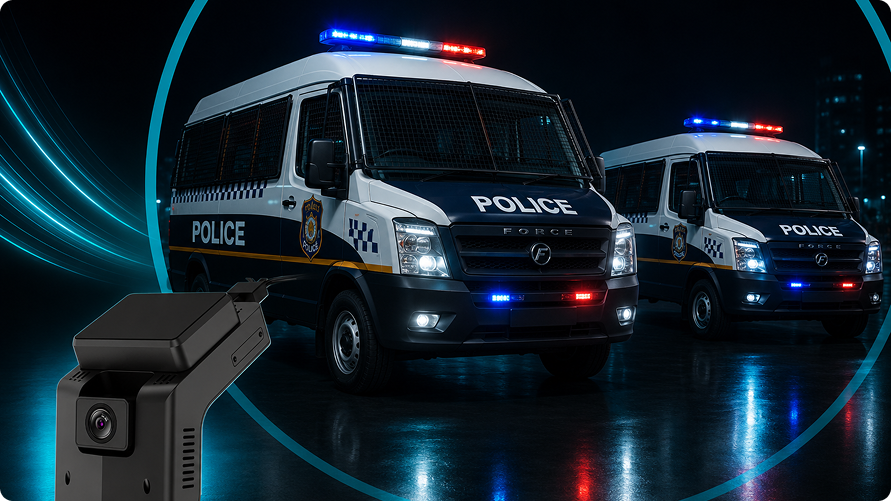
Smarter Safety, Safer Citizens: Protecting Our Police
Introduction: Police Modern Policing in a Connected World
Law enforcement agencies around the world face increasing demands for greater transparency, accountability, officer safety and operational efficiency. Police officers routinely manage traffic, respond to emergencies, investigate crimes and protect communities often in high risk environments where reliable evidence and real-time situational awareness are critical.
This case study examines these challenges through the example of India. While the statistics and initiatives presented are specific to India, they reflect common priorities for police agencies worldwide.
Under Prime Minister Narendra Modi’s SMART Policing vision, promoting policing that is strict and sensitive, modern and mobile, alert and accountable, reliable and responsive, techno-savvy and trained - law enforcement agencies across India have increasingly embraced technology to improve policing standards.
Video telematics and dashcams have become an important part of this transformation by providing objective digital evidence, enhancing officer safety, improving operational transparency and strengthening public trust. With more than 460,000 road accidents annually and thousands of law enforcement interactions taking place everyday, police fleets require secure, reliable recording systems that support both effective policing and public accountability.
The Problem: Operational Challenges & Rising Costs
Although the following statistics are related specifically to India, they highlight operational challenges shared by police agencies across the world.
- Legal liability & Compensation Costs: Police departments increasingly face financial liabilities arising from allegations of misconduct and wrongful arrests. In India, the Bombay High Court ordered compensation of ₹1 lakh/US $1,039 in a wrongful arrest case, while the National Human Rights Commission (NHRC) and various State Human Rights Commissions regularly award financial relief ranging from ₹2 lakh/US $2,078 to ₹5 lakh/US $5,194 in cases involving police misconduct. These expenses divert funding that could otherwise support fleet modernization, equipment upgrades, and officer training.
- Deadly Road Accidents Involving Police Officers: Road safety remains a significant concern for police fleets. Between 2011 and 2015, 371 police officers in Maharashtra (a state in India) lost their lives in road accidents while on duty, accounting for 87% of all duty-related fatalities during that period. More recent incidents, including fatalities involving police officers in Patna, Rajasthan, and Haryana (states in India) - highlight the ongoing risks associated with emergency vehicle operations. Without continuous video evidence, determining accident liability can be difficult, potentially exposing officers and departments to unnecessary legal disputes.
- Limited Evidence Collection & Complex Investigations: Without onboard video recording, police vehicles can become critical evidence gaps during investigations. Traffic stops, emergency responses, vehicle pursuits, accident investigations, and public interactions often occur without comprehensive digital records. As a result, investigators may have to rely solely on witness testimony, increasing the complexity of legal proceedings. Video evidence helps strengthen court cases, supports officer testimony, reduces disputes over events, and minimizes the administrative burden associated with manual documentation.
- Lack of Accountability and Damaged Public Trust: When allegations of police misconduct arise without supporting video evidence, investigations often become difficult to resolve objectively. Although Indian courts have imposed penalties ranging between ₹25,000/US $260 and ₹35,000/US $364 for false allegations in certain cases, the absence of reliable video evidence can make it challenging to protect officers against unfounded complaints while also identifying genuine misconduct. This can affect both officer morale and public confidence.
- Budget Constraints & Fleet Modernization: Like many public-sector organizations globally, police departments must modernize their vehicle fleets while operating within limited budgets.
For example, the Delhi Police spent approximately ₹50 crore/US $5.19 million annually on VIP vehicle rentals and ₹15 crore/US $1.56 million maintaining 3,500 vehicles during 2013-14. Kerala allocated ₹75.5 crore/US $7.84 million for 600 new police vehicles, while Kolkata Police invested ₹44 crore/US $4.57 million in 200 electric vehicles. Although the Government of India allocated ₹25,060 crore/US $2.60 billion over three years for police modernization, infrastructure gaps remain, with 267 police stations lacking telephone connectivity and 129 lacking wireless communication systems.
The Solution: iTriangle’s AW500 Dashcam System
The AW500 is a game-changer, specifically designed to solve these major problems for fleets. It offers a powerful combination of features made to boost safety and efficiency:
- Dual HD Cameras for Complete Visibility: The AW500 features dual cameras, a 1080P Full HD road-facing camera and a 720P HD cabin-facing camera, both offering a 140° wide-angle field of view. This provides continuous high-definition recording of vehicle surroundings, officer activity, emergency responses, traffic stops, and pursuit operations, creating reliable digital evidence.
- AI-Powered Driver Safety: The integrated Driver Monitoring System (DMS) continuously detects driver fatigue, distraction, mobile phone usage, and smoking, providing real-time voice alerts to reduce accident risks. The built-in Advanced Driver Assistance System (ADAS) further improves officer safety by warning drivers about potential forward collisions, lane departures, and pedestrians, particularly valuable during emergency response and high-speed operations.
- Cloud Storage & Real-Time Evidence Management: The AW500 automatically uploads critical event footage to secure cloud storage together with GPS location and timestamp information. Live GPS tracking enhances command center visibility, improves fleet coordination, and supports faster emergency response. The integrated SOS functionality enables officers to instantly notify supervisors while simultaneously preserving supporting video evidence.
- DVVP Certified & Ready for MoRTH Regulations: The AW500 is DVVP-certified and compliant with upcoming MoRTH video telematics requirements in India. Its future-ready architecture also helps police agencies prepare for evolving fleet safety and video telematics regulations across international markets.
- Built for Mission-Critical Operations: The AW500 incorporates Wide Dynamic Range (WDR) technology for clear recordings under varying lighting conditions. Its integrated sensor automatically detects collisions and preserves incident footage, while loop recording ensures continuous video capture. Built-in speakers provide real-time voice alerts and driver coaching, and the system integrates seamlessly with existing police fleet management and communication platforms.
Key Benefits: Saving Money, Improving Safety & Enhancing Operational Efficiency
- Avoiding Costly Lawsuits: Dashcams provide reliable, objective video evidence that can significantly reduce costly legal disputes and false claims. As highlighted compensation payouts can reach ₹15 lakh/US $15,583 per incident, making even a single prevented claim enough to justify the investment in the AW500. Courts imposing penalties of ₹25,000/US $260-₹35,000/US $364 for false allegations further demonstrate the value of video evidence in protecting both officers and law enforcement agencies.
- Preventing Accidents and Reducing Insurance Costs: The AW500's AI-powered safety features help reduce vehicle accidents by identifying risky driving behavior in real time. This lowers repair expenses, medical costs, and insurance claims. In this case study, police departments spend crores annually on vehicle maintenance, with some repairs exceeding the value of the vehicles themselves. Dashcams also help accelerate insurance claim resolution while discouraging fraudulent claims.
- Stronger Evidence & Higher Investigation Success: High-definition video evidence improves investigations by eliminating conflicting accounts and providing verified visual records. Automatic recording of traffic violations with GPS coordinates and timestamps supports efficient enforcement and digital evidence management. For example, in India, traffic fine collections increased by 163% after deploying similar technologies, demonstrating the operational value of video-enabled policing.
- Future-Ready Compliance & Warranty Protection: By supporting ISO 184 compliance and aligning with upcoming MoRTH video telematics guidelines (relevant for India), the AW500 helps fleets prepare for evolving regulatory requirements while protecting vehicle warranties from claims related to driver behavior. The same future-ready architecture also supports organizations operating in markets adopting advanced video telematics standards.
- Smarter Fleet Operations: Live GPS tracking and cloud connectivity provide centralized fleet visibility, faster incident response, and remote supervision. Automatic evidence uploads reduce administrative workload, allowing officers to focus on frontline operations while improving overall fleet productivity and public safety.
- Improved Officer Safety & Confidence: Continuous AI-based monitoring helps reduce fatigue-related incidents and enables faster emergency response through SOS alerts. Objective video evidence protects officers against false allegations while promoting accountability, improving morale, and supporting staff retention.
- Building Public Trust: Transparent, tamper-proof video evidence strengthens accountability and increases confidence in law enforcement. Sharing verified footage when appropriate helps resolve disputes quickly, supports community policing initiatives, and enhances the credibility of police agencies.
Conclusion: A Must-Have for Modern Policing
Law enforcement agencies worldwide are under increasing pressure to improve transparency, officer safety, operational efficiency, and accountability. The India case study demonstrates how rising legal costs, vehicle accidents, and public expectations make advanced video telematics an operational necessity rather than a luxury.
iTriangle’s AW500 combines AI-powered safety, dual-camera recording, cloud-based evidence management, and real-time fleet visibility into a single intelligent solution. By helping reduce legal exposure, improve officer safety, strengthen investigations, and streamline fleet operations, it delivers measurable value for police organizations globally.
Whether deployed in metropolitan police fleets, highway patrol vehicles, or public safety agencies, the AW500 enables smarter, safer, and more accountable policing.
Equip your fleet with the AW500 today and build a safer, more transparent future for law enforcement.
Featured Products
FLEETNEX AW500

Applicable Markets:
🇮🇳 India
In Partnership With: