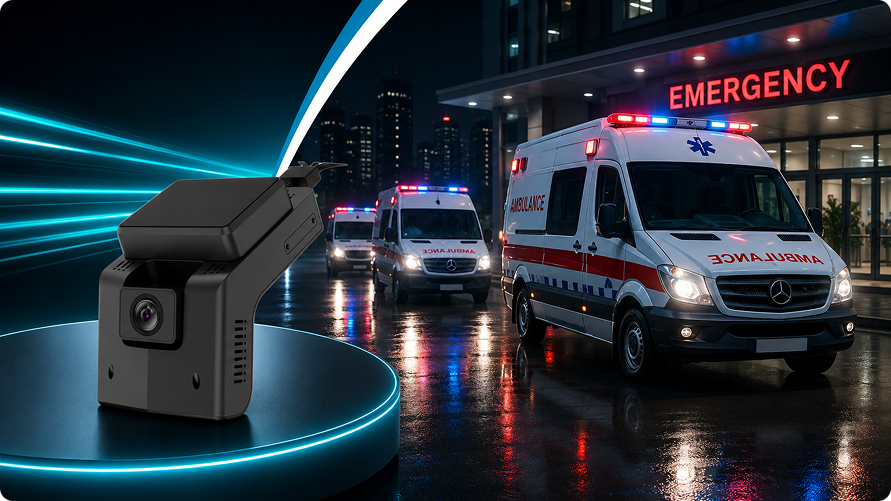
Saving Lives, Every Second Counts: Why Indian Ambulances Need Dashcams?
Introduction: Emergency Medical Services Under Pressure.
Emergency Medical Services (EMS) worldwide operate under immense pressure, where every second can determine patient outcomes. Ambulance crews must navigate congested urban roads, rural highways, and unpredictable traffic while ensuring patients receive medical attention within the critical “golden hour,” the first 60 minutes after a severe injury, when timely treatment can reduce mortality by up to 50%.
This case study examines these challenges through the example of India. While the statistics presented are specific to India, they reflect operational challenges faced by ambulance and emergency response fleets across many countries. According to available data, 95% of ambulances in India operate without adequately trained medical staff, while 90% lack basic emergency equipment or oxygen support. As a result, nearly 30% of preventable deaths occur before patients receive appropriate medical care. Integrating intelligent video telematics and dashcams provides greater operational visibility, enhances accountability, improves fleet safety, and strengthens emergency response management.
The Problem: Operational Gaps, Rising Costs, and Safety Risks
- Delays in Emergency Response: Studies conducted across Indian highways and urban road networks show that ambulances frequently require 20-30 minutes to travel less than 10 kilometres in congested cities. Rural routes also suffer from poor road infrastructure and traffic bottlenecks, delaying emergency response. In Karnataka, approximately 15% of accident victims waited more than 30 minutes for ambulance dispatch, highlighting the importance of improved fleet visibility and route optimization.
- Road Accidents & Insurance Costs: Ambulance drivers often operate under extreme time pressure, increasing the risk of collisions while responding to emergencies. These accidents endanger patients, medical personnel, and other road users. Across India's commercial transport sector, road accidents contribute to annual losses of approximately $4.99 billion USD, illustrating the broader financial risks associated with fleet incidents. Without reliable video evidence, insurance claims become more complex, leading to higher premiums, prolonged investigations, and increased legal costs for ambulance operators.
- Accountability & Legal Protection: Without continuous video recording inside and outside ambulances, disputes may arise regarding accident liability, patient handling, or staff conduct. Such cases can result in expensive litigation and regulatory scrutiny. Recognizing these benefits, the Punjab & Haryana High Court directed ambulances operating in Chandigarh (a state in India) to install dashcams to improve accountability. Clear video evidence strengthens public confidence while helping emergency service providers resolve disputes more efficiently.
- Budget Constraints & Aging Fleet Technology: Although India's ambulance fleet has grown by 57.5% since 2012, the country still remains below global healthcare recommendations of one ambulance per 100,000 people. Current availability stands at approximately 0.88 Advanced Life Support (ALS) ambulances and 1.25 Basic Life Support (BLS) ambulances per 100,000 people. Budget limitations and the cost of deploying GPS tracking, telematics, and advanced safety systems continue to slow digital transformation across many emergency fleets.
The Solution: iTriangle’s AW500 Dashcam System
- Two HD Cameras for Complete Visibility: The AW500 features dual cameras, a 1080P Full HD road-facing camera and a 720P HD cabin-facing camera, both offering a 140° wide-angle view. This provides comprehensive visual records of emergency response journeys, patient handovers, driver behavior, and on-scene conditions.
- AI-Powered Driver Safety: Built-in Artificial Intelligence continuously monitors driver behavior to detect fatigue, distraction, mobile phone usage, and smoking, providing instant voice alerts that help reduce accident risks. The integrated Advanced Driver Assistance System (ADAS) further enhances safety by warning drivers about potential forward collisions, lane departures, and pedestrians, particularly valuable during high-speed emergency response operations.
- DVVP Certified & Ready for MoRTH Regulations: The AW500 is DVVP-certified and compliant with upcoming MoRTH video telematics requirements in India. Its future-ready architecture also helps emergency fleets prepare for evolving safety and video telematics regulations in other markets.
- Cloud Connectivity & Real-Time Fleet Management: When the built-in sensor detects a collision or sudden braking event, or when an emergency button is activated, video footage is automatically uploaded to secure cloud storage together with GPS location and timestamps. This creates a tamper-resistant digital record while enabling hospital command centers to coordinate ambulance dispatch, optimize routing, and respond rapidly to emergencies.
- Built for Mission-Critical Operations: The AW500 incorporates Wide Dynamic Range (WDR) technology for clear video in challenging lighting conditions, while loop recording ensures uninterrupted video capture. The integrated sensor automatically preserves collision footage, and the system integrates easily with existing ambulance fleet management platforms, simplifying deployment across emergency service fleets.
Key Benefits: Safer Operations, Cost Savings, and Better Results
- Reduced Legal Costs: Clear video evidence helps reduce fraudulent claims, simplify accident investigations, and lower legal expenses. Businesses lose an estimated $4.99 billion USD annually due to vehicle accidents. Preventing just one major legal claim, often exceeding $2,078 USD, can deliver a rapid return on investment for dashcam deployment.
- Accident Prevention & Lower Insurance Costs: Real-time driver alerts and ADAS warnings help reduce collisions, leading to lower repair costs, fewer injury claims, and improved fleet safety. Ambulance operators using advanced video telematics may also benefit from reduced insurance premiums, allowing the system to pay for itself within a relatively short period.
- Faster Emergency Response & Better Patient Outcomes: Live GPS tracking and intelligent route optimization help reduce dispatch delays and improve ambulance utilization. Faster response times increase the likelihood of patients receiving treatment within the critical “golden hour,” improving survival rates while enabling more efficient use of limited Advanced Life Support (ALS) ambulances.
- Simplified Evidence & Fleet Management: Automatic cloud uploads and secure video storage eliminate the need for manual footage retrieval and reduce administrative workload. This allows emergency personnel to focus on patient care while reducing the time required for incident documentation and case preparation by up to 30%.
- Regulatory Compliance & Warranty Protection: By supporting ISO 184 compliance and India's upcoming MoRTH video telematics guidelines, the AW500 helps ambulance operators prepare for evolving regulatory requirements. It also helps reduce future upgrade costs and minimizes potential warranty disputes associated with driver behavior, protecting high-value vehicle components.
- Improved Staff Confidence & Public Trust: Objective video records protect ambulance crews against false allegations while promoting greater accountability. They also improve staff confidence and retention. Where appropriate, non-sensitive footage can be used to demonstrate transparency, helping strengthen public trust in emergency medical services.
Conclusion: Why Have Dashcams Become Essential?
As demonstrated in the India case study, ambulance fleets face growing challenges including delayed response times, road accidents, legal disputes, budget constraints and increasing operational costs. These issues affect not only fleet efficiency but also patient safety and public confidence.
The AW500 addresses these challenges through AI-powered driver assistance, dual-camera recording, cloud-based evidence management, and real-time fleet visibility. The result is improved safety, stronger legal protection, lower operating costs and better emergency response performance.
While the statistics presented in this case study are specific to India, the operational challenges are shared by emergency medical service providers around the world. Intelligent video telematics enables ambulance fleets to reduce preventable risks, improve accountability, and deliver faster, more reliable emergency care.
Equip your ambulance fleet with iTriangle’s AW500 to enhance driver safety, strengthen operational efficiency, control rising costs, and build greater public trust in emergency medical services
Contact iTriangle to schedule a demonstration of the AW500 and discover how intelligent video telematics can transform emergency fleet operations.
Featured Products
FLEETNEX AW500

Applicable Markets:
🇮🇳 India
In Partnership With: