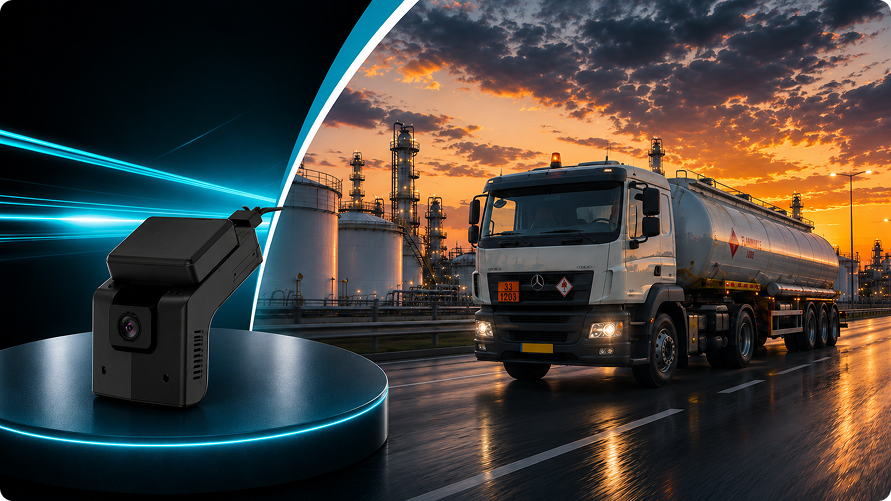
Oil & Gas Transport: Keeping Your Fleet Safe with iTriangle’s AW500 Dashcam
Introduction: The High Risks of Moving Oil & Gas
Transporting oil, gas, and other hazardous materials is one of the most demanding and high-risk operations in the global logistics industry. A single incident can result in severe environmental damage, loss of life, regulatory penalties, operational disruption, and substantial financial losses. India is the world’s third-largest oil consumer, with demand expected to increase by 50% by 2030. This growth places even greater importance on fleets transporting highly flammable products such as petrol, LPG, diesel, and hazardous chemicals across thousands of kilometres every day.
Transporting hazardous materials inherently involves significant risks because these products are highly flammable and, in some cases, explosive. In India, an analysis of 50 LPG tanker accidents between 2009 and 2020 found that 50% involved tanker rollovers, while 26% were head-on collisions. A recent example was the Jaipur tanker accident in December 2024, where a chemical truck collided with an LPG tanker, resulting in 14 fatalities, more than 40 injuries, and a massive fire that spread nearly 300 metres, destroying dozens of vehicles. Although these statistics are from India, they highlight safety challenges commonly faced by hazardous material transport operations worldwide.
Regulatory requirements governing hazardous goods transportation are also becoming increasingly stringent across global markets. The Bureau of Indian Standards (BIS) introduced updated guidelines in 2023 to improve the safe transportation of dangerous goods. These measures became increasingly important as more than 5,000 hazardous material transport accidents were reported in 2021, resulting in over 1,000 fatalities and thousands of injuries. Similar regulatory developments are taking place worldwide as governments strengthen safety standards for hazardous goods transportation.
The Problem: Serious Dangers and Hidden Costs
Too Many Crashes and High Insurance Bills:
India’s oil and gas transport industry faces shocking accident numbers that directly lead to huge financial problems. Indian Oil Corporation Limited reported 113 big road and fire accidents during fuel transport from 2014-2019.
Bharat Petroleum Corporation Limited had 65 major accidents, and Hindustan Petroleum Corporation Limited reported 18 big accidents in the same time. Remember, these are just the officially reported incidents; the actual number of crashes is probably much higher.
The insurance market for dangerous goods transport shows how risky this is. Special insurance policies for hazmat trucks cost anywhere from ₹12,200/US $127 to ₹28,000/US $291 each year, which is about 15-30% more than what regular trucks pay. But the real money drain happens when claims are settled. In a recent case, a tanker owner was told to pay ₹26.30 lakh/US $27,326 in compensation because his insurance didn’t pay out. Why? The driver didn’t have the required special license to carry dangerous goods. The Punjab and Haryana High Court also made an insurance company pay ₹54,650/US $568 to an oil carrier company for tanker damage, which shows how complicated these situations can be.
Drivers Breaking Rules All the Time and Not Following Laws:
Driver compliance remains one of the most critical challenges in hazardous goods transportation worldwide. Enforcement authorities have reported numerous violations involving intoxicated driving, invalid licenses, and inadequate hazardous material certifications. In one notable incident, a Mumbai court sentenced a tanker driver to seven days imprisonment, imposed a ₹2,500/US $26 fine, and suspended the vehicle permit for 60 days after the driver was found heavily intoxicated with 379 mg of alcohol per 100 ml of blood. Subsequent investigations also revealed that the driver lacked a valid driving licence.
India’s Supreme Court has further clarified that drivers transporting hazardous materials must possess the mandatory Rule 9 endorsement on their licences. Failure to comply allows insurance providers to recover accident compensation from vehicle owners, significantly increasing the financial liability of fleet operators. Similar licensing and certification requirements exist across many international markets, making driver qualification management a global compliance priority.
Huge Losses from Fuel Theft:
Fuel theft is a constant drain on oil and gas transport businesses, with smart criminal groups operating all over India. Recent arrests in Bathinda uncovered organized fuel theft where criminals used copied master keys to steal 100-200 liters from each tanker. Police found 32 drums of petrol, 18 drums of diesel, and equipment worth ₹8 lakh/US $8,312. In Mumbai, eleven people were arrested for stealing 12,000 liters of diesel worth ₹19 lakh/US $19,741 from Indian Oil tankers.
These criminals were stealing 150-200 liters daily and selling it for ₹65/US $0.68 per liter. The amount of fuel being stolen is truly shocking. Government figures show that 57 cases of crude oil theft during transport were caught in just one year, up from 47 cases the year before. Investigations in Karnataka revealed organized theft where criminals messed with tanker locking systems using magnets and special tools. One case involved the theft of 500 liters of diesel worth ₹25,000/US $260.
Rising Fines and Costs to Follow Rules:
The fines for breaking oil and gas transport rules are getting much, much higher. The Civil Aviation Ministry’s proposed rules for dangerous goods transport include fines from ₹10,000/US $104 to ₹1 crore/US $103,900. Serious violations, like moving dangerous goods without proper approval, could mean penalties from ₹25 lakh/US $25,975 to ₹1 crore/US $103,900. If environmental damage occurs, companies could face fines up to ₹10 crore/US $1.04 million, and ₹25 crore/US $2.60 million for ongoing violations.
The Petroleum and Natural Gas Regulatory Board now strictly says that oil product tankers cannot be driven at night, specifically between 11 PM IST and 6 AM IST. Companies also have to send monthly reports to show they are following this. Breaking hazardous materials transport rules can lead to jail time of up to three years and fines up to ₹5,000/US $52 for the first time, and then ₹5,000/US $52 fines and three years in prison for repeat offenses.
The Solution: iTriangle’s AW500 Smart AI Dashcam System
- Two HD Cameras for a Full View: The AW500 addresses the unique challenges of hazardous goods transportation through its advanced dual-camera architecture. It simultaneously records the road ahead in 1080P Full HD and the driver cabin in 720P HD, both with a wide 140° field of view. This provides continuous visual evidence covering vehicle movement, route adherence, driver behaviour, loading and unloading activities, and emergency situations. The comprehensive recording capability supports operational monitoring, accident investigations, regulatory documentation, and legal evidence requirements across hazardous goods transportation fleets worldwide.
- AI-Powered Driver Safety & Risk Prevention: The special Artificial Intelligence (AI) built into the system directly helps with the big safety problems oil and gas fleets face. It uses a Driver Monitoring System (DMS) to watch the driver in real-time. The system can tell if a driver is sleepy, looking away from the road, using a phone, or smoking – all very dangerous when carrying flammable goods. Advanced Driver Assistance Systems (ADAS) give warnings about possible crashes ahead, if the truck leaves its lane, and can even spot people walking. These are vital for stopping the kinds of accidents that have badly hurt this industry.
- DVVP Certified & Ready for MoRTH Rules: For commercial vehicle manufacturers and fleet operators in India, the AW500 is already prepared for upcoming MoRTH video telematics requirements and holds DVVP certification, helping organizations avoid costly future upgrades while supporting long-term regulatory compliance.
- Secure Cloud Storage and Anti-Theft Protection: The AW500 combines rugged hardware with secure cloud-based evidence management to help combat cargo and fuel theft. Event-triggered recordings, including sudden braking, collisions, or manual alerts, are automatically uploaded with encrypted GPS coordinates and timestamped metadata, creating tamper-proof evidence for investigations. Continuous monitoring enables fleet managers to identify unauthorized route deviations, unexpected stoppages, and suspicious activities in real time, allowing faster intervention and improved asset protection.
- Evidence Ready for Compliance & Legal Requirements: Wide Dynamic Range (WDR) technology ensures consistently clear recordings under challenging lighting conditions, including night-time operations, tunnels, glare, and low-light environments. The integrated sensor automatically preserves collision footage, while continuous loop recording ensures uninterrupted video capture throughout every journey. The AW500 integrates seamlessly with existing fleet management platforms, telematics systems, and reporting tools, providing a comprehensive evidence management solution that supports regulatory compliance, operational transparency, and legal investigations across hazardous goods transportation fleets worldwide.
Key Benefits: Less Risk and More Savings
The AW500’s clear video evidence can greatly lower your insurance costs and protect you from false claims. Since insurance policies cost 15-30% more than regular commercial coverage, preventing just one major claim can save you many times the cost of the system. With compensation payments reaching ₹26.30 lakh/US $27,326 per incident and disputes often going in favor of those with proper documentation, the financial protection is huge.
- Stopping Fuel Theft and Stolen Goods: Real-time monitoring and route tracking directly solve the ongoing fuel theft problem. With cases of 12,000-liter thefts valued at ₹19 lakh/US $19,741 and regular theft operations stealing 150-200 liters daily, the AW500’s ability to spot unapproved stops and route changes provides an instant return on your investment by preventing theft.
- Following Rules and Avoiding Fines: The system’s complete recording helps you follow the increasingly strict rules. With fines from ₹10,000/US $104 to ₹1 crore/US $103,900 for dangerous goods violations and jail terms up to three years for hazmat transport violations, the AW500’s evidence capabilities offer vital protection against government actions.
- Faster Emergency Response and Incident Handling: The built-in SOS button and automatic emergency recording allow for quick response to hazardous material incidents. Given how disastrous oil and gas accidents can be, immediate help can stop small problems from becoming huge catastrophes with massive environmental and financial consequences.
Conclusion: Why You Must Act Now?
India’s oil and gas transport sector is at a critical point, facing many safety risks, government checks, and financial pressures that demand immediate use of new technology. With 113 major accidents reported by Indian Oil Corporation alone in five years, compensation payouts reaching ₹26.30 lakh/US $27,326 per incident, organized fuel theft operations stealing millions of liters every year, and new government fines up to ₹1 crore/US $103,900, the current way of operating just can’t last.
The AW500 provides a comprehensive solution to these challenges. Its AI-powered monitoring, secure anti-tampering features, and legally reliable evidence management system directly address the key risks faced by hazardous material transport operators. Businesses that delay implementation continue to remain exposed to accident liabilities, theft-related losses, operational disruptions, and increasing regulatory challenges.
Every day without AW500 protection increases vulnerability to accidents, theft, and compliance risks affecting oil and gas transportation operations worldwide. With global energy demand continuing to rise and safety regulations becoming more stringent, organizations adopting advanced safety technologies early can gain a competitive advantage through improved risk management, reduced insurance costs, better compliance, and enhanced operational efficiency.
The choice is clear: invest in the AW500 to protect your business, drivers, assets, and profitability. Or continue facing the growing costs associated with accidents, theft, regulatory penalties, and operational inefficiencies.
Contact iTriangle today to schedule your AW500 demonstration and transform the way you manage hazardous material transportation. The future of safe, compliant, and efficient oil and gas transport depends on taking the right action today.
Featured Products
FleetNex AW500

Applicable Markets:
🇮🇳 India
In Partnership With: